faint signals
The field guide
The vocabulary for what you're feeling, because you can't notice what you can't name.
Most guys can name two sensations down there: nothing, and orgasm. That's a vocabulary of two words for a range with dozens in it.
That's a real problem, not a poetic one. If your only categories are nothing and everything, then everything short of everything gets filed as nothing. You'll walk straight past your own progress for months.
So here's the field guide. Think of it like a birdwatcher's book. You're not trying to see all of them. You're learning the names so you can recognise one when it turns up.
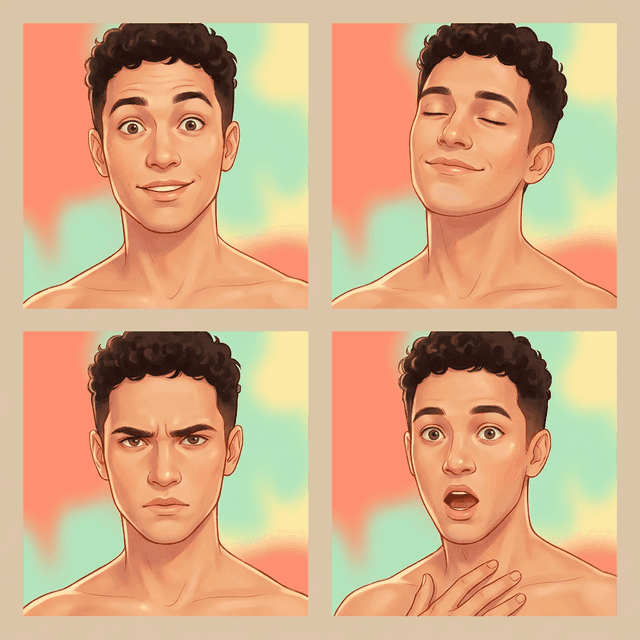
The quiet end
These are the ones almost everyone gets first, and almost everyone dismisses.
Warmth. A patch of heat somewhere between your navel and your rosebud, with nothing causing it.
Fullness. A sense of weight or presence that isn't the toy. Often described as heaviness, low down.
A faint pulse. Something ticking gently in time with nothing in particular.
Tingle. Fizzing or prickling, usually shallow and easy to miss.
A twitch. A small movement you didn't ask for. Level 7 is built entirely around these.
The middle
Aching. A dull, not-unpleasant heaviness, often described as similar to the feeling just before you need to come but without the urgency.
Radiating. Warmth or pressure that spreads outward instead of staying put. Usually into the perineum, the base of the dick, or the inner thighs.
Waves. Something that builds and fades and builds again on its own. Not you doing it. Level 8 is where these live.
A pull. A sense of being drawn inward or upward, like something is gently tugging.
Involuntary clenching. Your pelvic floor squeezing without instruction, often rhythmically.
The loud end
We're naming these so you know they exist, not so you can go looking for them.
Chills. Full-body, often up the spine, often with goosebumps.
Shaking. Legs or hips trembling on their own.
Heat flooding. A sudden spread of warmth over a much wider area than makes sense.
Losing the edges. Difficulty locating exactly where the sensation is, or what's touching what.
Practising with nothing in
The most useful habit in this whole level costs nothing and doesn't require you to be anywhere in particular.
That does two things. It builds the noticing skill in the cheapest possible setting, and it means you turn up to actual sessions already able to find the place rather than spending the first twenty minutes locating it.
One man's version of this went further and it's worth knowing, because more than one person reports it working: he'd deliberately imagine the sensation he wanted, in detail, before it was there — and found that pretending eventually tipped over into feeling. Nobody can tell you why that works. It costs nothing to try on a Tuesday afternoon.
The ones that arrive when you're not looking
A category of their own, because they break the rule that this happens during sessions.
Buzz. A low background hum in the area, hours after you finished.
A wave out of nowhere. Something building and fading while you're sitting at a desk, on a train, or watching telly, with nothing inserted and nothing happening.
Inner goosebumps. Men reach for that phrase surprisingly often, and it describes it better than anything we could write: goosebumps, but on the inside.
These belong in the log like anything else, dated to the day they turned up rather than the session that probably caused them. They're one of the earliest signs that the wiring is changing rather than just responding.
How to use this
Two rules.
Read it before, not during. Going in with a checklist means you'll spend the session auditing yourself instead of feeling anything. Read it now, then forget it, then use it afterward to name what happened.
Log the faint ones. Especially the faint ones. Those are the ones you'll otherwise decide were nothing, and they're the ones that show up first.
One thing we're not telling you
How many there are.
There's no complete list, no set to collect, and no order they arrive in. Your version of any of these might not match the description, and that's fine. The names are handles, not targets.
If you feel something that isn't on this list, that's not a mistake. That's the field guide being incomplete, which every field guide is.