slack off
Squeeze. Now unsqueeze.
Both halves of the pelvic floor, because letting go is the half nobody trains and it's the one that matters here.
Everybody has heard of kegels. Squeeze the muscle, hold, let go, repeat. Good for you, apparently.
Here's what almost nobody gets told: squeezing is half the exercise. The half you skip is the half that matters most for this.
What the research says
A 2025 review of pelvic physical therapy for male sexual function found two things worth your time.
Relaxing your pelvic floor is required to get an erection. Not helpful for. Required. Tension down there works against you.
You need to be able to contract and relax in a coordinated way for the whole system to work properly. Both directions, on purpose, under your control.
So a program that only trains squeezing trains half a skill. And it's the wrong half to have on its own.
The other useful number comes from the first proper trial in this area, back in 2004. Men doing pelvic floor exercises with biofeedback, forty percent got normal erectile function back. Worth knowing the flip side too: the guys who still had weak pelvic floors afterward were the ones who didn't improve.
So this isn't "relax more and you're done" either. Weak is a problem. Tense is a problem. You want a muscle that does what you tell it, both ways.
What you're actually moving
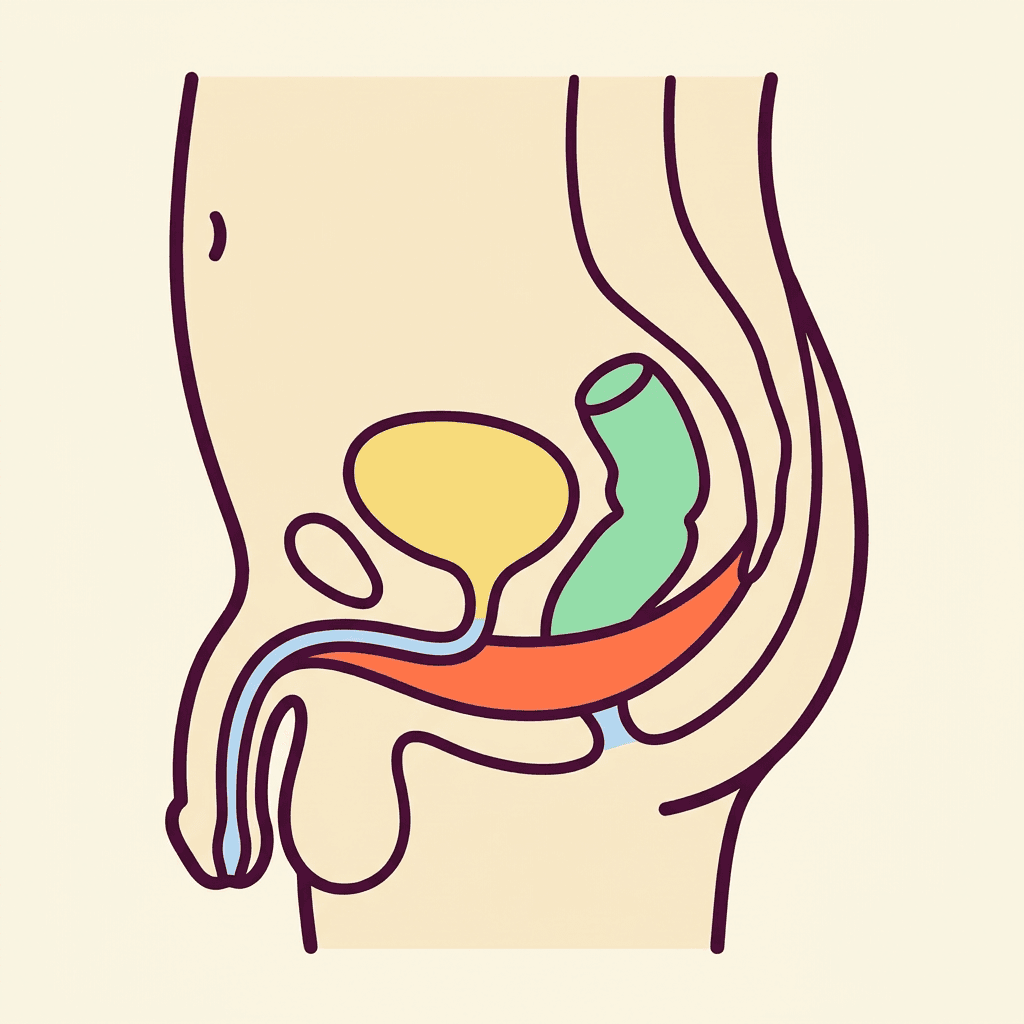
That sling of muscle is the thing. Squeezing pulls it up. Releasing lets it drop. Same muscle, two jobs, and you want both on command.
Finding the muscle
Two ways, both easy.
The pee test. Next time you're mid-stream, stop it. That muscle you just used is the one. Do this once to find it, then stop doing it, because holding your pee mid-stream regularly is not good for you.
The lift test. Stand up and try to lift your balls without using your hands. That squeeze is the same muscle group.
You're feeling for a lift and squeeze deep inside, not your abs and not your butt cheeks. If your stomach tightens or your cakes clench, you've grabbed the wrong thing. Start over smaller.
The squeeze
- Lift and hold for three seconds.
- Let go completely for three seconds.
- Ten of those. That's one set.
Breathe the whole time. Guys hold their breath doing these and don't notice.
How hard
Harder is not better, and this is the single most useful number in the whole lesson.
One way to find it: squeeze the smallest amount that you can still feel, and stop there. That's the setting. If you're gripping hard enough to notice effort, you've overshot by a mile.
This matters more later than it does now. From Level 6 onward you'll be using tiny contractions with something inserted, and the instinct will be to squeeze harder when nothing seems to be happening. Squeezing harder is the reliable way to make less happen.
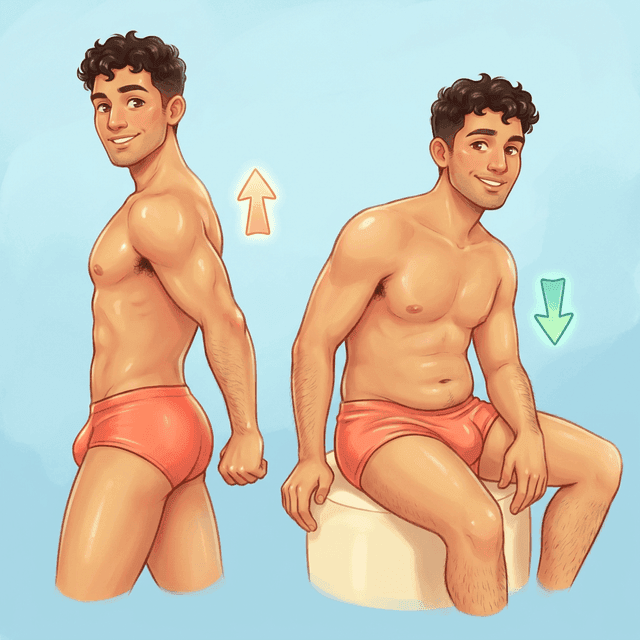
The unsqueeze, which is the actual point
This is a reverse kegel, and it's the one you came for.
Instead of lifting, you're pushing gently down and out. Like the very beginning of a poo, but stopped almost before it starts. Or like letting a fart go quietly. That's the motion.
It feels wrong. It feels like nothing. Most guys can't find it for a week or two, and that's normal.
Some things that help:
- Do it on an out-breath. Breathe out, and let go downward.
- Put a hand on your perineum, between your balls and your rosebud. You want to feel it bulge slightly outward, not pull up.
- Don't push hard. This is a release, not a strain. If you're red in the face, back off.
Five slow ones, then stop. Longer isn't better.
What the release actually does, once something's in there
This is why we're bothering, and it's worth reading now even though it's a Level 8 problem.
Men who describe the moment it finally worked keep describing the same switch. They build with small inward squeezes, and then at the point where something starts happening they stop squeezing and bear down instead — the release, held for ten seconds or more, while the pressure inside stays exactly where it is.
That's the whole reason a muscle you can't feel doing anything is worth five minutes a day now. The squeeze builds. The release is what you'll actually be doing at the moment that matters, and it is not a thing you can learn on the night.
Why we're making a fuss about this half
In the communities where guys talk about this, kegels come up roughly five times as often as reverse kegels.
That gap is the problem in one statistic. Everyone trains the squeeze because it's obvious and it feels like exercise. Almost nobody trains the release, because it feels like doing nothing.
The release is what lets something in without a fight. It's what you'll use in every session from Level 3 onward.
The dissenting view, which is worth hearing
Not everyone thinks you should be doing this yet.
There's a camp that argues training the squeeze before you can feel anything inside is pointless — that you're just clenching muscles at nothing, and that contractions only start doing useful work once there's a sensation there for them to act on. Their order is: learn to feel it first, and the muscle work becomes obvious afterwards.
We've put this level here anyway, for one reason: the release half is what Level 3 needs, and that half is worth having in place before anything goes anywhere near you. Nobody in that camp disputes the relaxing.
So if the squeezing feels like homework at nothing right now, it partly is. Do the five slow releases and treat the rest as optional until it starts connecting to something.
How often
Once a day is plenty. Two sets of squeezes, five slow releases. Five minutes.
You can do them anywhere and nobody can tell, which is either useful or a bad idea depending on the meeting.
Skip days without guilt. This is a muscle, not a streak.
If it hurts
Aching afterward like any new exercise is fine. Pain during is not.
If you get pain that hangs around, or pain when you poo, or a tear that isn't healing, stop the exercises and see a doctor. Pelvic floor problems are a real thing with real treatment, and a physio who works on them is a genuinely useful person to know.